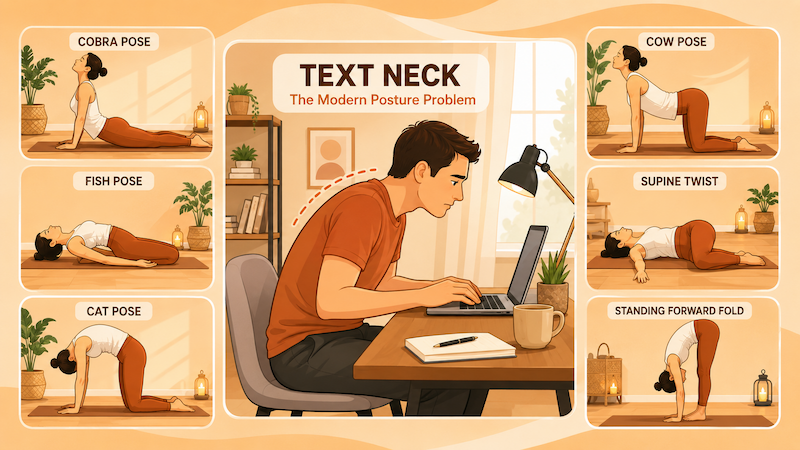
If your neck feels stiff after hours on a laptop or your shoulders ache after scrolling on your phone, your screen habits may be contributing to the problem. Spending long periods with your head tilted forward can place extra strain on the muscles of the neck and upper back, leading to the pattern commonly called tech neck.
The good news is that small changes can make a difference. In this guide, you’ll learn what causes tech neck, the signs to watch for, and seven yoga-based stretches and exercises that can help ease tension, improve neck mobility, and counter long hours of screen use.
Tech neck, also called text neck or computer neck syndrome, describes neck and upper-back pain or stiffness associated with prolonged forward-head posture while using phones, laptops, and other screens. It is not a formal medical diagnosis, but a common pattern of muscle and joint strain.
When your head stays forward for long periods, the muscles around the neck, shoulders, and upper back have to work harder to support it. Over time, this can contribute to:
See a healthcare professional if you experience arm or hand weakness, persistent tingling or numbness, pain that wakes you at night, or symptoms that began after an injury. These signs may point to something other than simple posture-related muscle strain.
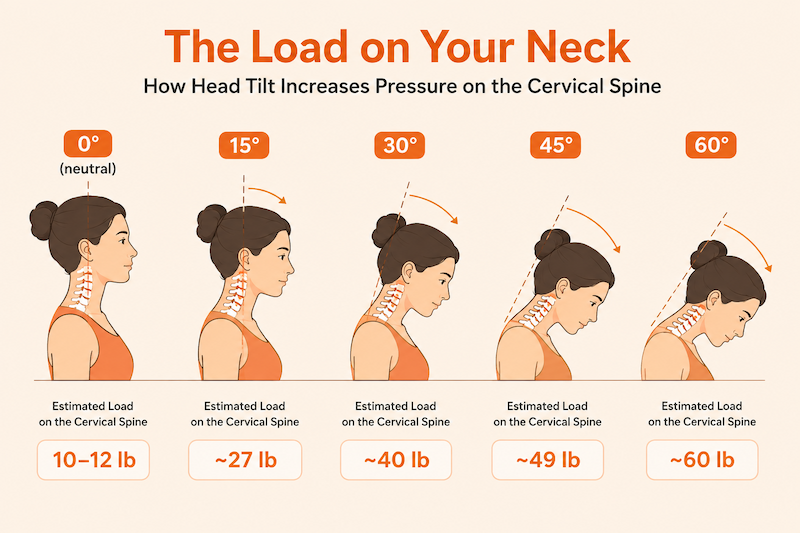
Forward head posture develops when the head stays in front of the shoulders for long periods instead of being balanced over the spine.
A neutral adult head weighs roughly 10–12 lb, but as it tilts forward, the neck muscles have to work against a much longer lever. A 2014 biomechanical analysis by Kenneth Hansraj estimated that the force on the cervical spine rises sharply as the angle increases.
Screens make this position easy to repeat for hours.
Pew Research Center reports that 90% of U.S. adults own a smartphone and 41% say they are online almost constantly. Looking down at a phone in bed, working with a laptop low on your lap, or leaning toward a monitor can all keep the head forward. But screens are not the only cause—the same mechanical load can develop during any prolonged head-down task.
Over time, forward head posture may be accompanied by a muscle-imbalance pattern commonly called upper crossed syndrome, first described by Vladimir Janda. In this pattern, some muscles become tight or overactive while others become weak or underactive.
This helps explain why “just sit up straighter” often does not last. If the muscles responsible for supporting the neck and shoulder blades fatigue easily, the head gradually moves forward again. Corrective exercise therefore needs both sides of the equation: lengthen what has become tight and strengthen what has become weak.
[inline-CTA-1]
Treat neck exercises differently from a deep hamstring or hip stretch. Move slowly, stay within a comfortable range, and never force your head farther simply to feel a stronger stretch. Short, regular sessions are generally a better starting point than one long, aggressive session.
Stop and seek medical advice if an exercise causes sharp pain, tingling or numbness down the arm, dizziness during neck extension, or symptoms that began after an injury. Arm numbness, tingling, weakness, and neck pain following trauma can signal a problem that needs medical assessment rather than routine posture exercises.
A useful tech neck routine should do more than stretch sore muscles. Because forward head posture often involves both tight muscles and weak postural muscles, the sequence below starts by strengthening the deep neck and upper-back muscles, then restores mobility, and finishes by lengthening areas that commonly become tight.
Some of the best tech neck exercises include:
Targets: Deep cervical flexors at the front of the neck
Hold / reps: Hold for 5 seconds; repeat 8–10 times.
Modification: Practise with your back against a wall for easier alignment.
Skip this if: It causes dizziness, sharp pain, or tingling into the arm or hand.
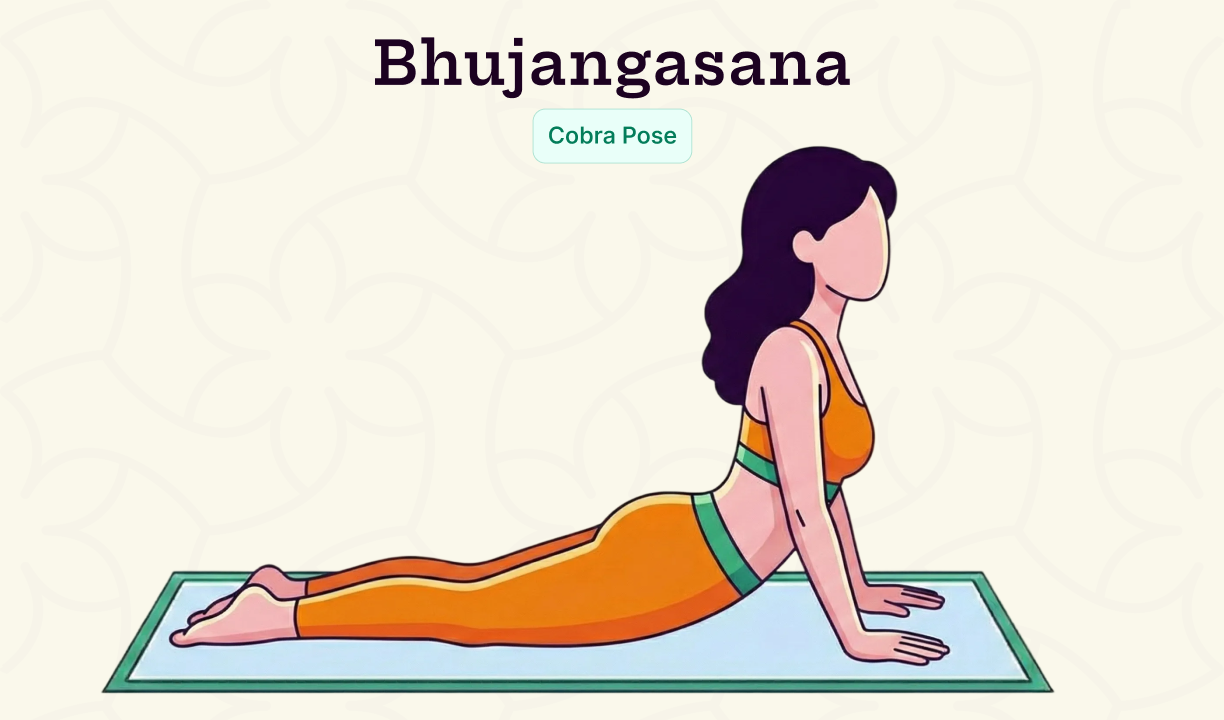
Targets: Upper-back extensors, lower trapezius, chest, and shoulders
Hold / reps: Hold for 10–20 seconds; repeat 2–3 times.
Modification: Lift only a few inches and keep most of the effort in your upper back.
Skip this if: The pose increases neck or lower-back pain.
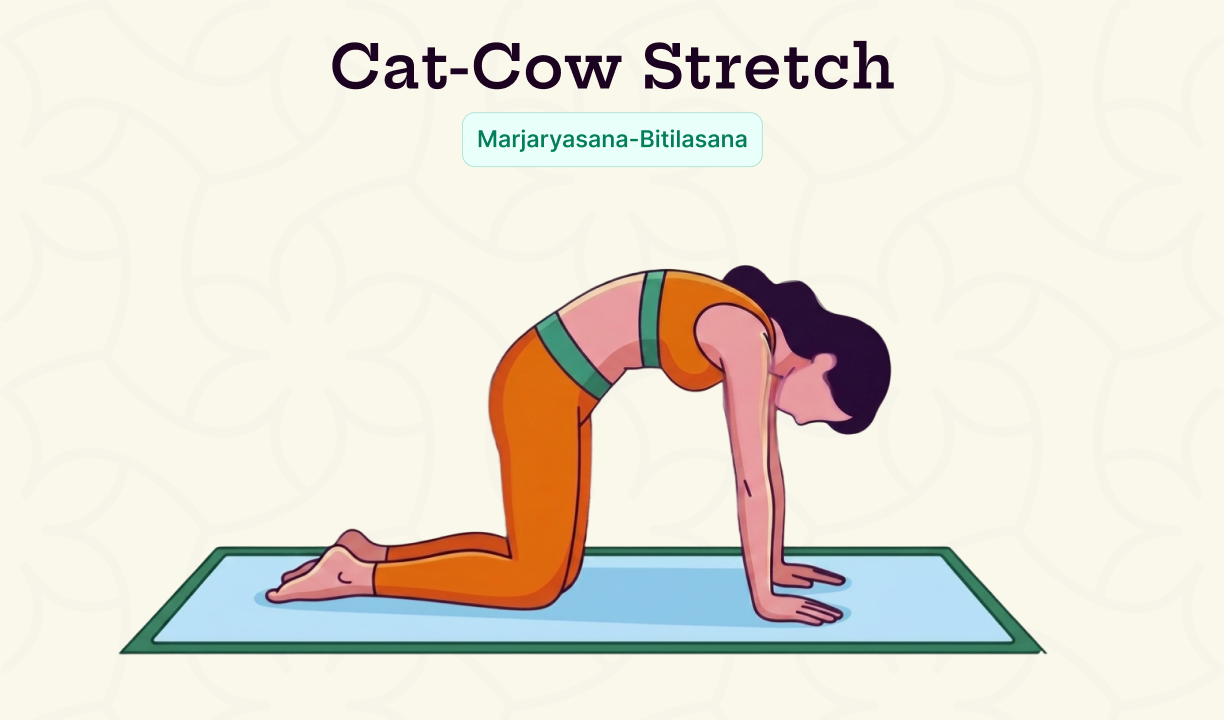
Targets: Cervical and thoracic spine, upper-back muscles, and chest
Hold / reps: Complete 8–10 slow rounds.
Modification: Make the spinal movement smaller if your neck feels stiff.
Skip this if: Flexing or extending your neck produces pain, dizziness, or radiating symptoms.

Targets: Upper trapezius, rhomboids, shoulders, and thoracic spine
Hold / reps: Hold for 20–30 seconds per side.
Modification: Rest your head on a folded blanket or yoga block.
Skip this if: The twist increases shoulder, neck, or arm symptoms.
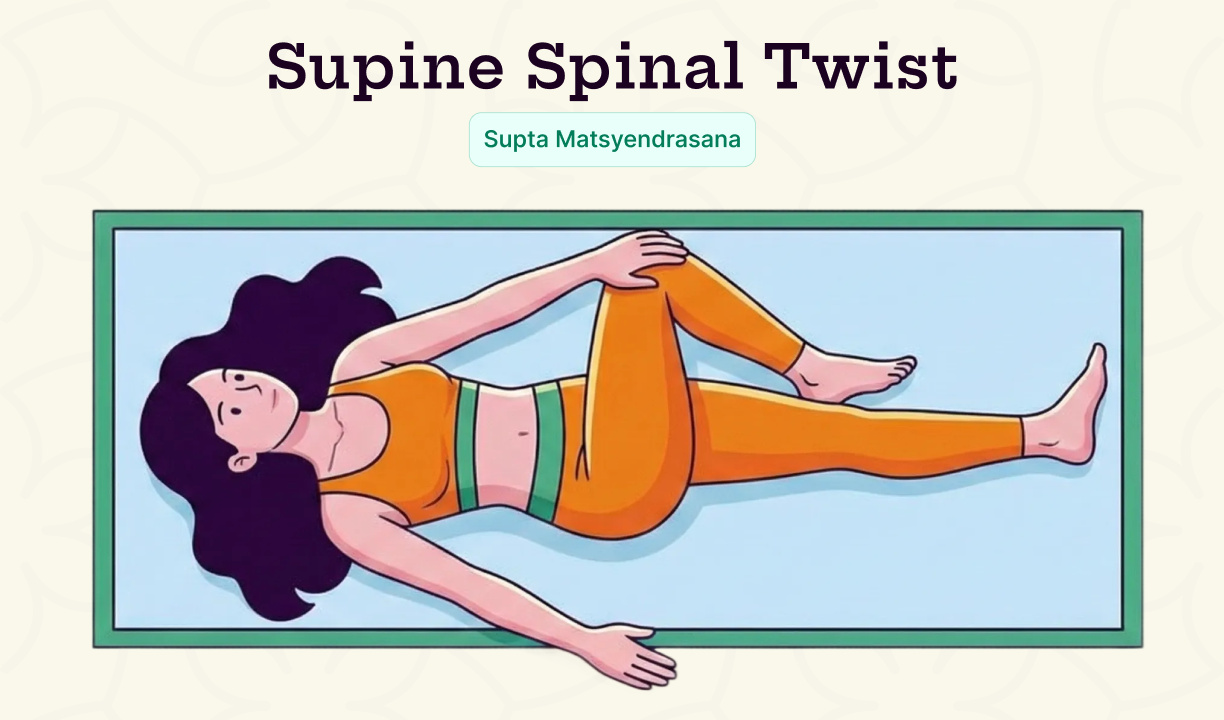
Targets: Thoracic spine, chest, shoulders, and muscles around the upper back
Hold / reps: Hold for 30–60 seconds per side.
Modification: Place a cushion beneath your knees for support.
Skip this if: Turning your head or torso causes sharp pain, numbness, or tingling.
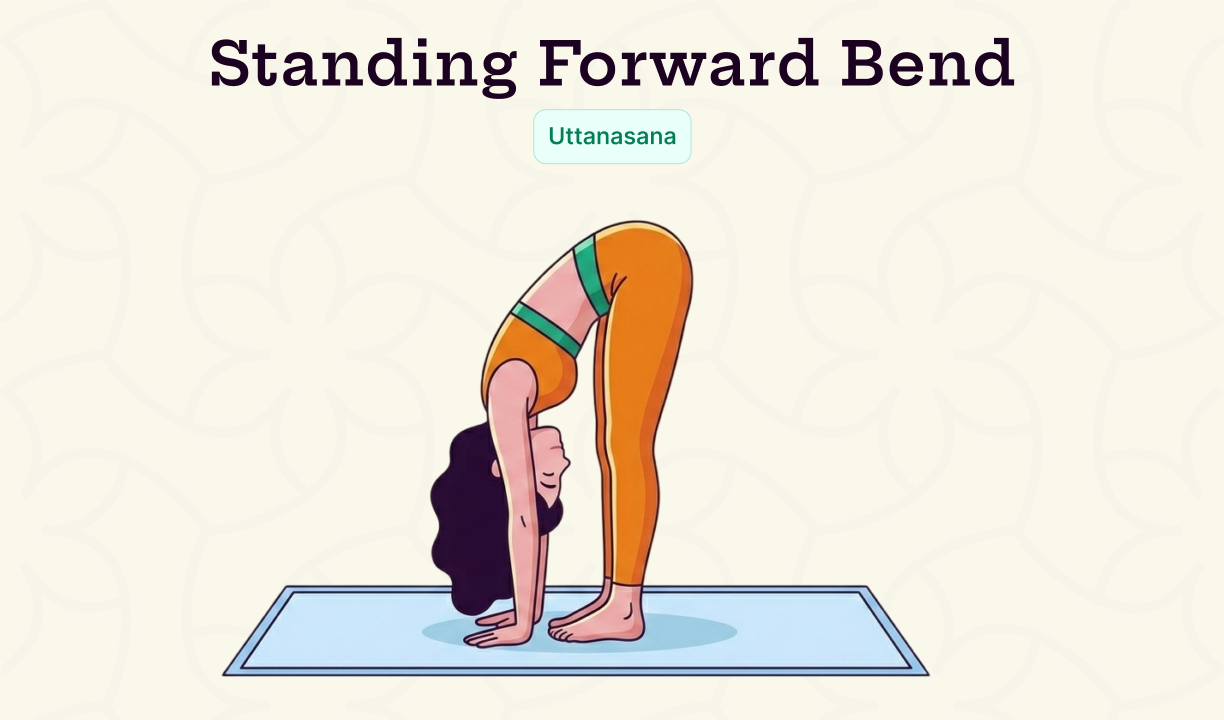
Targets: Upper trapezius, back muscles, hamstrings, and shoulders
Hold / reps: Stay for 5–8 comfortable breaths.
Modification: Bend your knees more deeply or rest your hands on blocks.
Skip this if: Having your head below your heart makes you dizzy or unwell.

Targets: Pectorals, front of the shoulders, upper chest, and front of the neck
Hold / reps: Start with 10–15 seconds; repeat up to 2 times.
Modification: Support your upper back on a bolster and keep your head more neutral.
Skip this if: Neck extension causes dizziness, sharp pain, numbness, tingling, or symptoms following a neck injury. Neck pain accompanied by neurological symptoms warrants medical assessment rather than routine stretching.
The order matters: strengthen the muscles that help hold your head over your shoulders, restore movement through the spine and shoulders, then gently lengthen the areas that have become tight. That addresses more of the pattern behind tech neck than stretching alone.
[Inline-CTA-2]
Consistency matters more than doing one long session. A few short movement breaks spread through the day can help you strengthen postural muscles, restore mobility, and prevent neck and shoulder tension from building up during screen time.
Use the morning to wake up the spine and reset your posture before spending time at a desk or on your phone.
Take a short break 2–3 times during the workday to bring your head out of its forward position and reactivate the muscles that support better posture.
Use the evening to release tension that has accumulated through the day while restoring movement through the chest, shoulders, and upper back.
You do not need to complete every exercise at every session. The goal is to strengthen regularly, move often, and avoid letting your neck stay in the same forward position for hours at a time.
[GC]
While tech neck exercises are powerful for relief, prevention is the long-term solution. Small changes in how you work can dramatically reduce the strain on your neck and shoulders.
Set Up an Ergonomic Workspace
Take Regular Movement Breaks
Practice Mindful Posture Cues
Tech neck can often improve with regular exercise, better screen positioning, and regular movement breaks, but it rarely changes overnight. Mild pain and stiffness may begin to ease within days or a couple of weeks, while meaningful improvements in neck strength, mobility, and forward head posture usually take longer.
Exercise studies on forward head posture commonly measure improvements after 4–8 weeks, and NHS physiotherapy guidance notes that noticeable changes in pain, movement, and strength can take 6–12 weeks.
How quickly tech neck improves also depends on what happens outside your exercise routine. Doing corrective exercises each evening will have limited impact if you return to the same low laptop or head-down phone position for eight hours the next day. Changing your workstation, taking movement breaks, strengthening the muscles that support the neck and shoulder blades, and reducing prolonged forward-head positions all matter.
Long-standing postural or structural changes may improve only partially, so the realistic goal is better movement, strength, and symptom control rather than forcing the neck into a “perfect” posture.

Tech neck symptoms and forward head posture can often improve with exercise and changes to your daily setup. The most useful approach combines strengthening weak neck and upper-back muscles with mobilizing and lengthening tight areas, rather than relying on stretching alone.
Common signs include neck stiffness, aching shoulders, pain between the shoulder blades, headaches, and reduced neck movement. Tingling, numbness, or weakness in an arm or hand needs more caution because it can indicate nerve involvement.
Some discomfort may settle within a few weeks, but improvements in posture, strength, and movement commonly require 6–12 weeks of consistent work. Your screen setup and how frequently you change position can influence progress.
For a quick movement reset, start with chin tucks and Cat-Cow to activate the deep neck muscles and restore spinal movement. Long-term improvement also requires strengthening, regular movement breaks, and reducing prolonged forward-head positions.
No. Tech neck describes a pattern of strain associated with sustained neck posture, while a pinched nerve involves pressure on a nerve. Radiating arm pain, numbness, tingling, or weakness are more suggestive of nerve involvement and should be assessed if persistent.
Neck problems can contribute to headaches, particularly when the muscles and tissues around the upper neck remain tense or irritated. Forward head posture has also been studied alongside tension-type headaches and increased suboccipital muscle tension.






Receive personalized guidance tailored to your unique fitness goals, live with a dedicated coach—no credit card required.

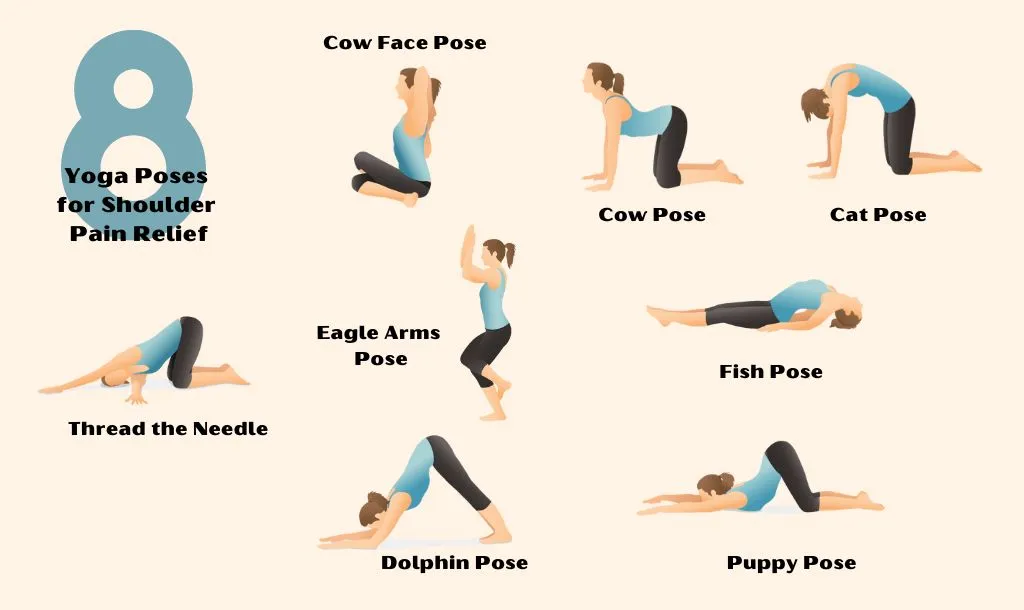
Discover 8 gentle yoga poses for shoulder pain relief. Expert-guided stretches for rotator cuff, shoulder blade pain, and tension. Start healing today!

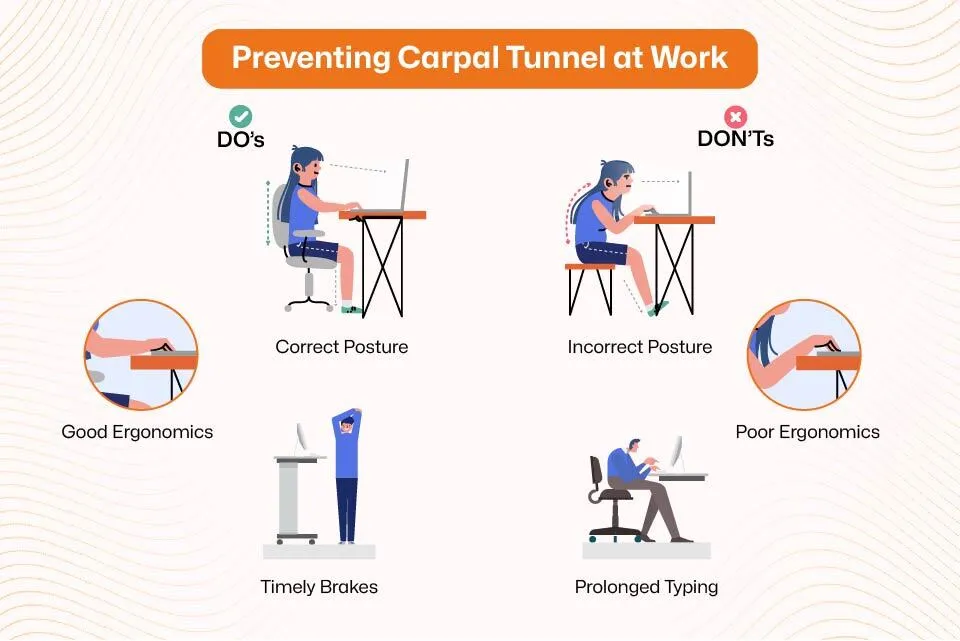
Wrist exercises can prevent the pain and numbness caused by carpal tunnel syndrome, especially if you work for long hours. Explore the best exercises here!
%20(2).webp)
Neck pain can make daily tasks like typing or talking on the phone feel challenging. Try these simple yoga poses to relieve the pain and live better!


© Copyright 2025 MyYogaTeacher Inc