-
A little Pink Matrix experiment…
I’ve been thinking about my own body lately:
I can do weights. I can do Down Dog. I can plank. I can practise Hatha, and my right shoulder is perfectly happy.
But I go for a walk or sit at my desk for a while, and sometimes that same shoulder starts to hurt intensely.
So I started wondering: What is different?
Is it the way I’m carrying myself when I walk?
Am I subtly leaning forward?
Is my arm hanging differently?
Am I holding my phone?
Is my breath changing?
Am I unconsciously holding or lifting that shoulder?
Or is something happening much further down, through my feet, pelvis or ribcage, that eventually shows up at my shoulder?Rather than immediately deciding “my shoulder is tight” or “my posture is bad”, I’m becoming curious about the conditions around the discomfort.
What happens if I walk without my phone?
What happens if I let my arms swing?
What happens if I soften the shoulder rather than trying to pull it back?
What happens if I change my pace?
What happens to my breath?
And perhaps most interestingly: What happens when I change just one thing?This is the kind of exploration that sits underneath Pink Matrix for me: learning to notice load, support, breath and adaptation, and becoming a little more curious about how my body responds.
Because sometimes the most useful information is what happens when we’re simply walking, sitting, standing, carrying, breathing and living.
And that’s what I want to explore with you.
Pink Matrix · 23–24 October
430-630pm PST
Two evening sessions · Hatha + YinI’ve been putting together a little workbook for it too, so you can capture what you discover and perhaps take some of those experiments back into your own practice.
I’m quite excited about this one.
Join me this weekend 23-24th Oct
[https://myyogateacher.com/workshops/pink-matrix:-the-tissues-that-carry-you?preview=true](link url)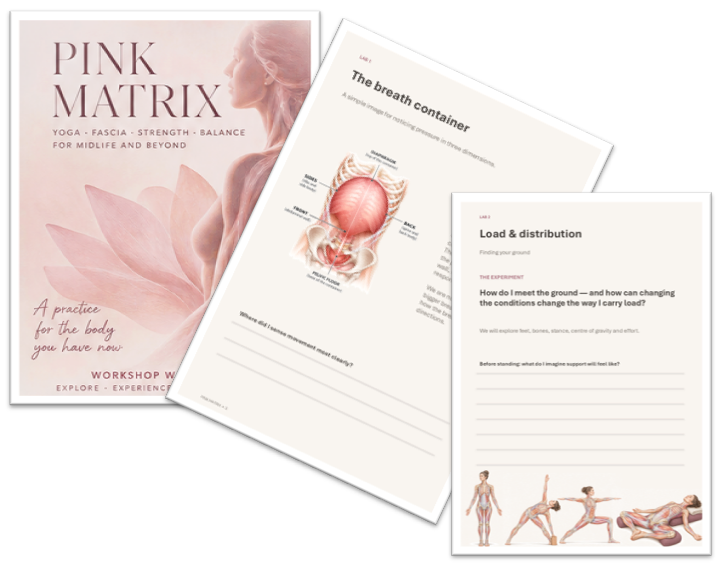
-
replied in "Introducing Our Teachers"
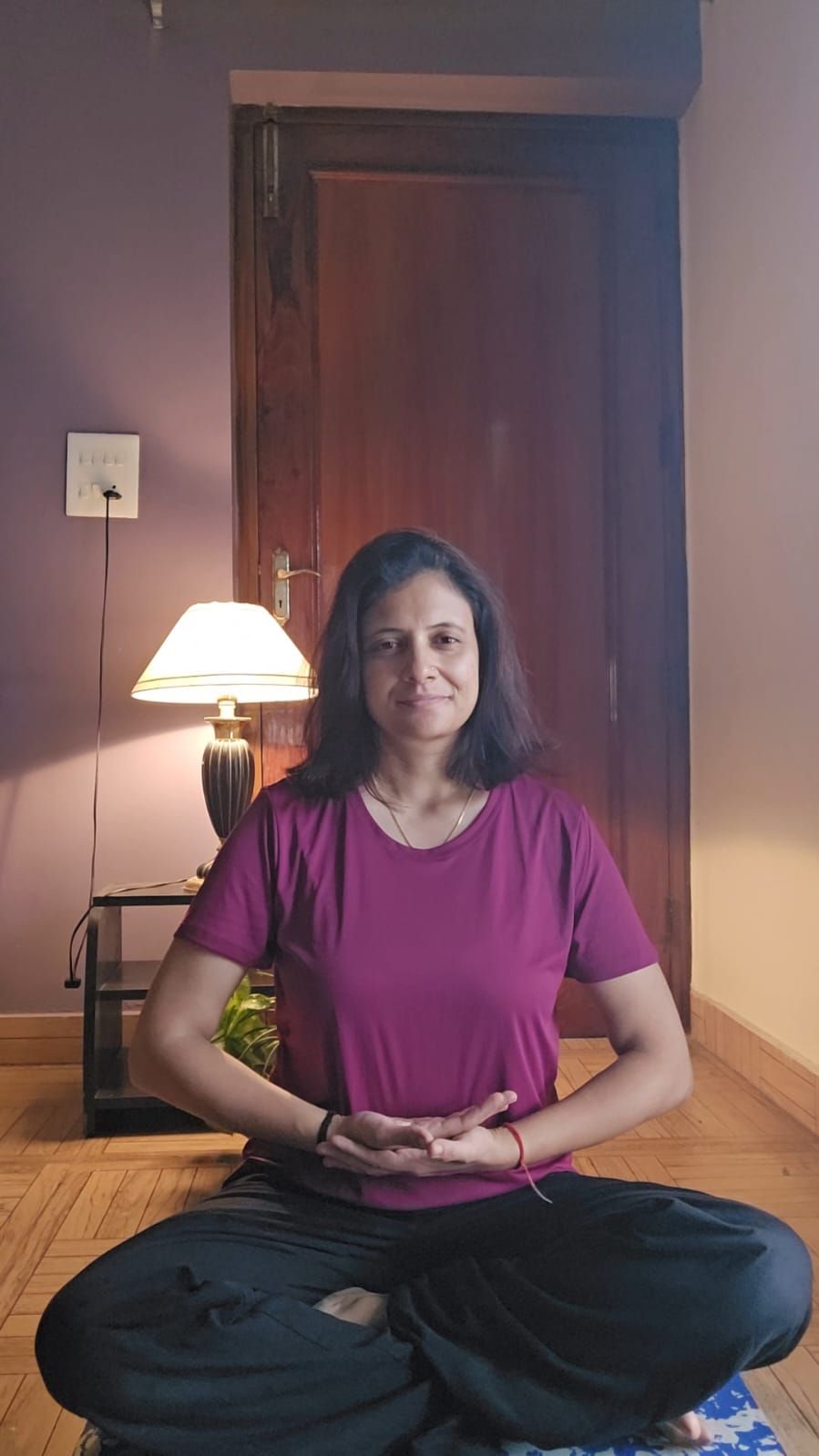
Hello Everyone, Meet Pranjali J
Pranjali J, a BAMS with a PG Diploma in Yogic Sciences, currently pursuing her Masters in Yoga.
She combines traditional yogic wisdom with alignment-based practices, Hatha Yoga, Ashtanga Yoga, pranayama, and mindful movement.
Having guided around 100–150 clients, she focuses on improving flexibility, strength, balance, and overall well-being.
Beyond yoga, she enjoys reading, gardening, and travelling, which keep her connected to nature and inspires her in teaching.
-
replied in "Introducing Our Teachers"
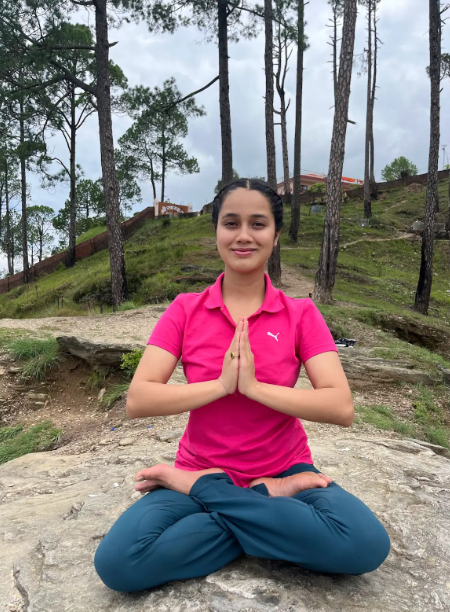
Hello Everyone , meet Devanshi B
Devanshi B , a certified Yoga Instructor and content creator with 6 years of yoga experience, including 5 years of teaching.
She has worked with 500+ clients, helping them manage PCOS/PCOD, thyroid concerns, hormonal imbalances, and weight through yoga and mindful movement.
Beyond teaching, she enjoys creating wellness content to inspire healthier lifestyles.
-
replied in "Introducing Our Teachers"
Hello Everyone, Meet Anamika S
Anamika’s yoga journey began as a student struggling with exam stress and anxiety, where yoga helped her find balance and inner peace.
Inspired by its transformation, she pursued a degree in Yogic Sciences and has spent over 8 years teaching yoga.
She specializes in prenatal and postnatal yoga, therapeutic practices, and managing lifestyle disorders, having guided over 2,500 clients of different ages toward better health and well-being.
Beyond yoga, Anamika loves dancing!

-
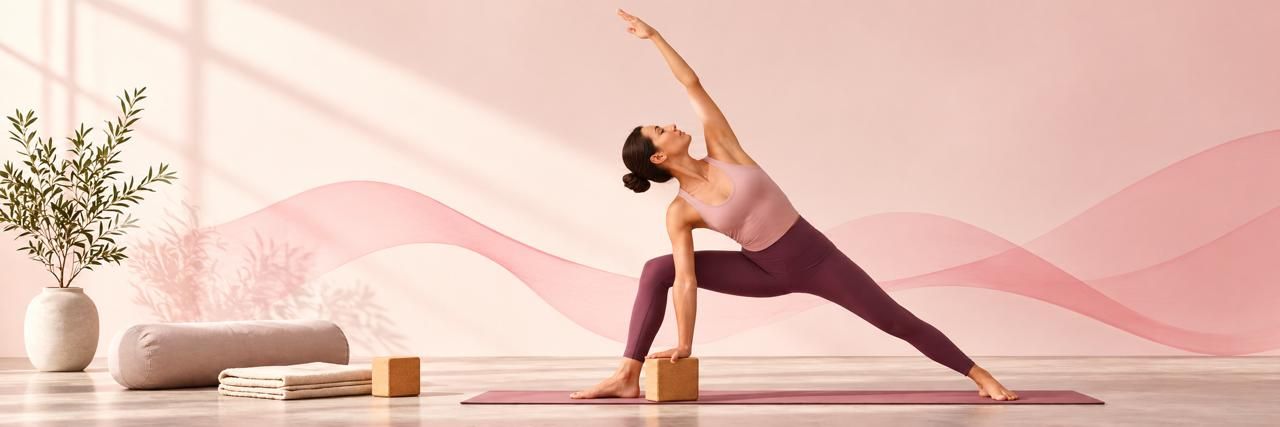
WORKSHOP FOR WOMEN: Pink Matrix: The Tissues That Carry You
About two years ago, I attended a conference called Pink Fascia. I was fascinated by what I learnt about fascia and connective tissue, and how much they contribute to the way our bodies move, respond and support us.
I came away wanting to bring some of these insights back to our community, but in my own way, through the yoga practices and explorations that we already know and love.
Over the years, teaching students with different bodies, needs, abilities and challenges has taught me something important: my job is to help you discover how to make the pose work for you vs fit you into a textbook picture of a pose.
When we understand the intention behind a pose, we can begin to explore our stance, our support and the way we use our bodies. Small changes can make a difference to how a pose feels and what we discover through it.
I’m trained in Hatha and Yin yoga, and love breaking a pose down into its foundational pieces, taking our time, and exploring. We try things on for size. We notice what works, what doesn’t, and what changes when we approach the pose differently.
In many ways, I teach Hatha a little like Yin. The difference is that Hatha invites more active engagement of the muscles, while Yin gives us an opportunity to soften, yield and be supported. Both offer us ways to understand our bodies better.
This is what I’d love to explore with you through the workshop.
Rather than a full yoga practice, we’ll spend time experimenting with movement, support, strength and balance. We’ll look at how changing our stance, angle, support or effort can change our experience of a pose.
And perhaps most importantly, we’ll learn to take that curiosity home with us.
Sometimes, in a regular group class, we don’t have the time to stay with a pose, try a few variations and really ‘marinate’ in the experience. But at home, you can return to one or two poses over several days. You can get to know them more intimately, notice your breath and your body’s responses, and gradually discover what works for you.
There isn’t necessarily one perfect version of a pose, or one solution that will work for us forever. Our bodies change, our needs change, and our practice can change with them.
That’s the spirit in which I’ve created Pink Matrix: to help you understand your body and make your practice your own.
Here’s where you can sign up for the 2-part workshop this 23 and 24th Oct 430-630pm PST.
[https://myyogateacher.com/workshops/pink-matrix:-the-tissues-that-carry-you?preview=true](link url)
-
New workshop for our community!
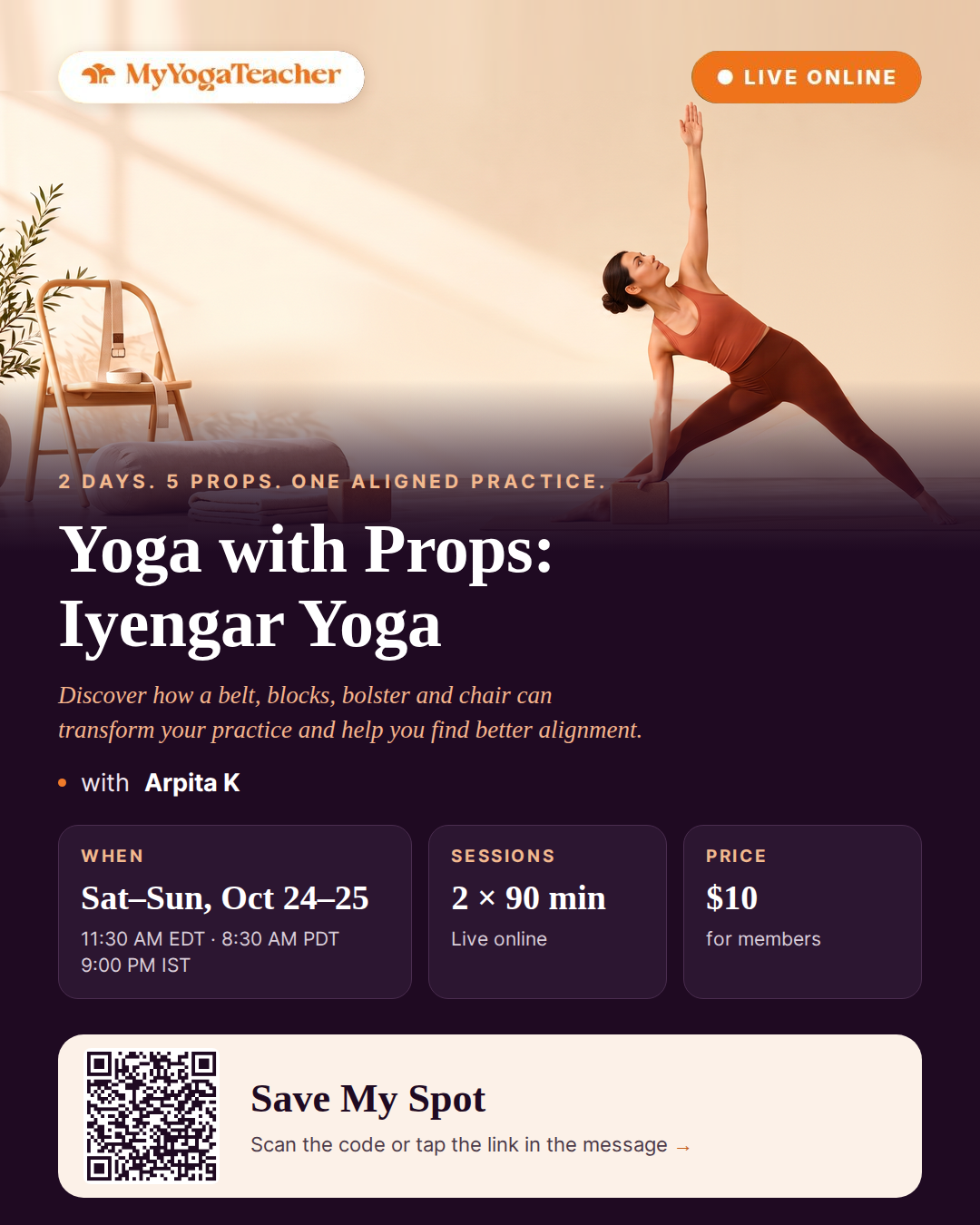
Yoga with Props: Iyengar Yoga 🧘
Step into Yoga with Props: Iyengar Yoga, a two-day workshop that shows you how simple props can change the way you practise, making poses steadier, safer and better aligned.Meet your teacher-Aprita
Arpita trained under Usha Devi, a senior Iyengar teacher and direct student of B.K.S. Iyengar himself. She holds a Master’s in Yoga Therapy and has helped 1,000+ people manage pain, stiffness and stress through personalised practice.What to expect:
Day 1 – Build your foundation: use a belt, blocks and the wall to refine alignment in standing and seated poses.
Day 2 – Restore & deepen: explore supported backbends with a chair and deep relaxation with a bolster.
A practice that fits your body: props make poses accessible for every level of flexibility, so you can work with ease instead of strain.Oct 24 and 25 | 2 × 90 min session
11:30 AM EDT · 8:30 AM PDT · 9:00 PM IST
$10 for members · Live onlineUse your props. Find your alignment. Feel the difference in every pose.
 Save your spot: https://myyogateacher.com/workshops/transform-your-practice-with-yoga-props
-
[New Workshop] The Power of Blindfold Yoga 🧘
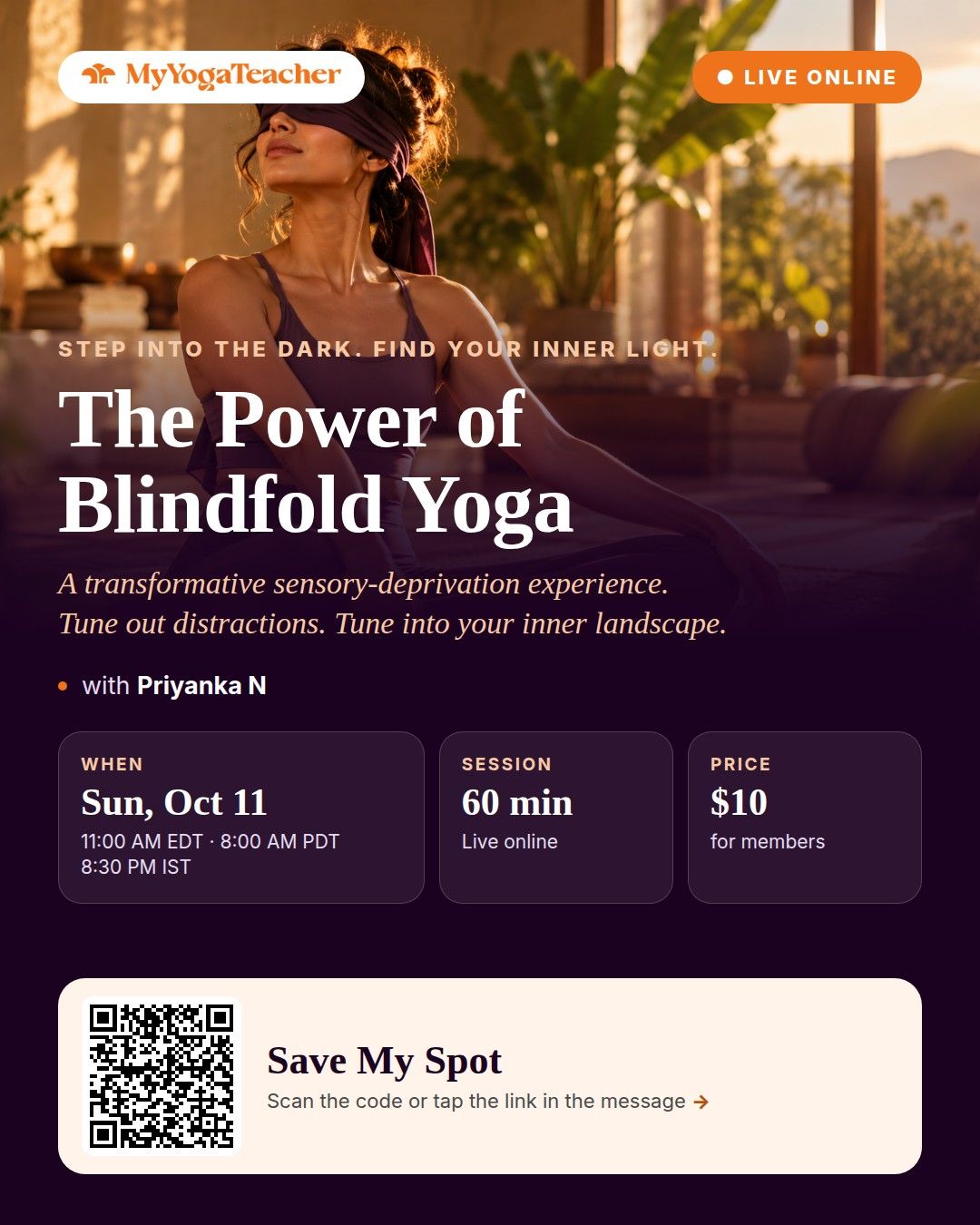
[Workshop Invite] The Power of Blindfold Yoga 🧘
Step into The Power of Blindfold Yoga - a slow, restorative experience designed to disconnect you from external distractions and bring you closer to your inner landscape.
What to expect:
- Eyes at rest: let go of visual cues and external distractions.
- A slow, restorative flow: move at a gentler pace and tune into how each movement feels.
- A more inward practice: shift your attention from how you look to how you feel.
Close your eyes. Slow down. Experience your practice from within.
 Sun, Oct 11 · 60 min
with Priyanka N
 11:00 AM EDT · 8:00 AM PDT · 8:30 PM IST
 ️ $10 for members · Live online
 Join The Power of Blindfold Yoga https://myyogateacher.com/workshops/the-power-of-blindfold-yoga?preview=true
-
We’re excited to bring some new classes to the community! 🧘
 ️
️
 Surya Namaskar for Strength and Flexibility
A dynamic 30-minute flow of Sun Salutations to build strength, improve flexibility, and generate internal heat. Suitable for all levels.
Mon–Sat | 8:00 PM IST | 10:30 AM ET | 4:30 PM CEST | 12:30 AM AEST (next day) | 6:30 PM GST
With Devyani M | Starting October 1
Join the class: https://myyogateacher.com/group-classes/surya-namaskar-for-strength-and-flexibility🧘 Beginner Yoga for Hips and Hamstrings
A gentle 30-minute class to loosen tight hips and hamstrings, ideal after long hours of sitting. Beginner-friendly.
Tue, Thu & Sat | 5:00 PM IST | 7:30 AM ET | 1:30 PM CEST | 9:30 PM AEST | 3:30 PM GST
With Devyani M | Starting October 1
Join the class: https://myyogateacher.com/group-classes/beginner-yoga-for-hips-and-hamstrings Yoga for Deep Twists and Detox
A 30-minute sequence of seated, standing, and supine twists to aid digestion, ease tension in the spine and abdomen, and support the body’s natural detox process.
Mon, Wed & Fri | 5:00 PM IST | 7:30 AM ET | 1:30 PM CEST | 9:30 PM AEST | 3:30 PM GST
With Devyani M | Starting October 1
Join the class: https://myyogateacher.com/group-classes/yoga-for-deep-twists-and-detox Intermediate Iyengar Yoga for Alignment and Strength
Build strength, flexibility, and alignment in this 60-minute intermediate class, using props and precise cues adapted to your body.
Mon, Wed & Fri | 7:30 PM IST | 10:00 AM ET | 4:00 PM CEST | 12:00 AM AEST (next day) | 6:00 PM GST
With Trupti | Starting October 12
Join the class: https://myyogateacher.com/group-classes/iyengar-yoga-by-trupti Come join us and explore something new!
-
replied in "Introducing Our Teachers"
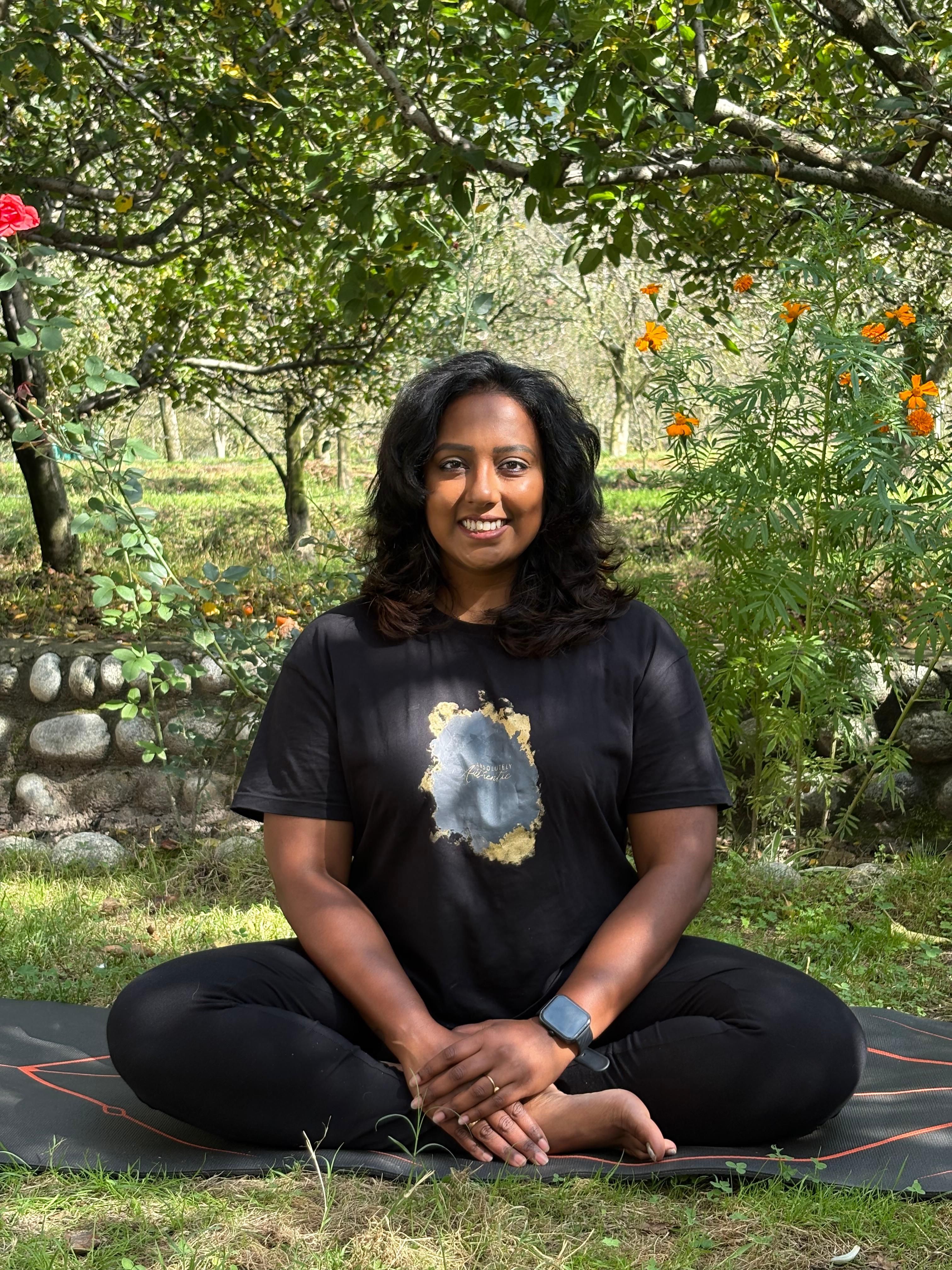
Hello Everyone, Meet Nithya K
Nithya is an internationally certified yoga teacher with over 15 years of teaching experience.
She have worked with thousands of students across different ages and fitness levels.
Her key specializations include therapeutic yoga, lifestyle-related concerns, women’s health, strength & mobility and stress management.
Beyond yoga, she loves baking which is her favorite creative outlet.
-
replied in "Introducing Our Teachers"
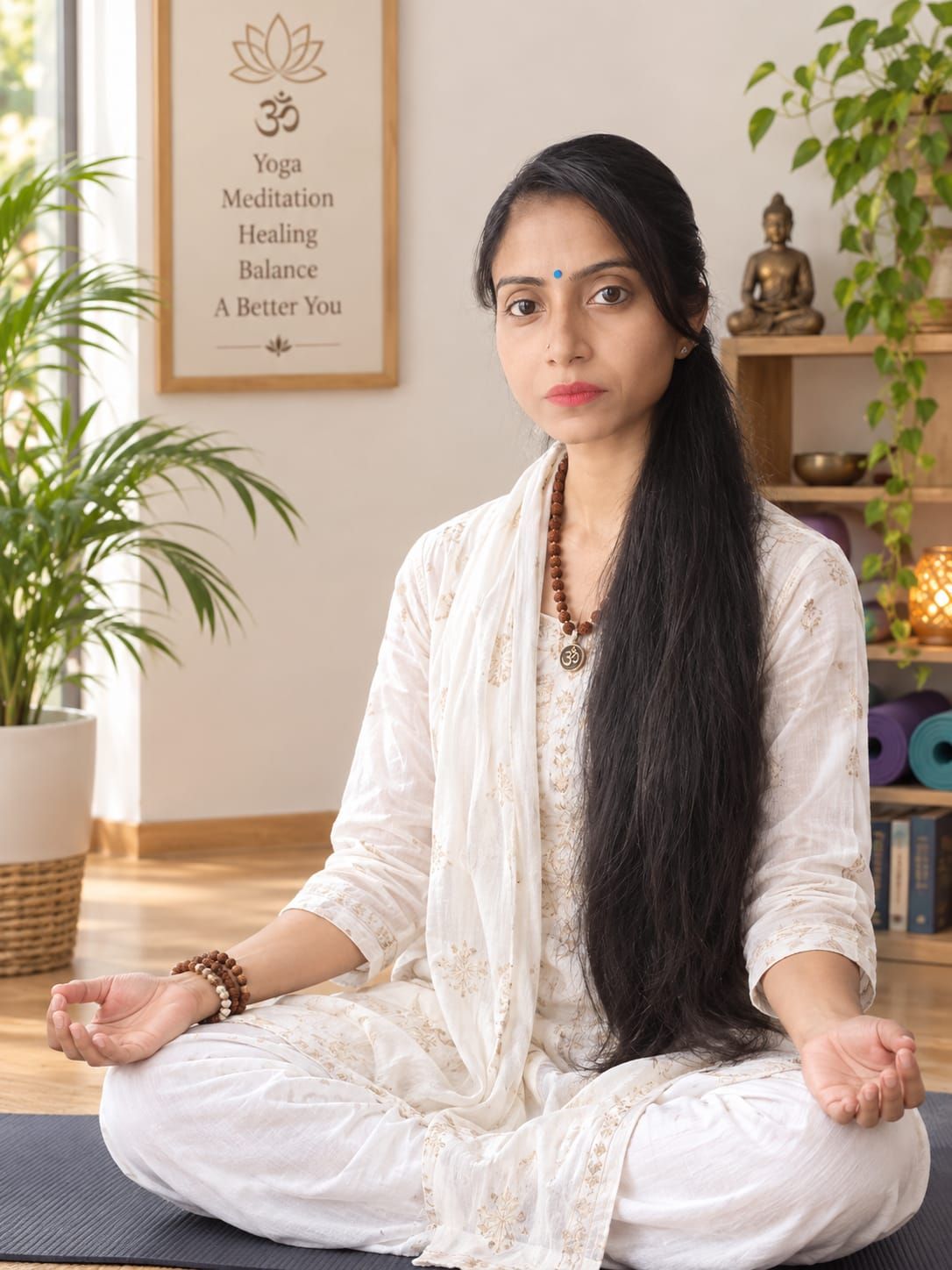
Hello Everyone Kanta
Kanta is a certified Yoga Teacher with a 300-hour Yoga Teacher Training certification, dedicated to helping people create balance between the body, mind, and soul.
Her teaching combines Asanas, Pranayama, Meditation, and mindful practices to make yoga accessible and meaningful for everyone.
She believes yoga is not just an exercise—it is a journey of self-awareness, healing, and inner transformation.
Her aim is to inspire every student to build strength, find peace, and live a healthier, more balanced life through the practice of yoga.She have 1.5 years of experience teaching yoga and other vedic metrology.
30 + clients have changed their life experience in yoga journeyHer hobby is reading spiritual and mythological books
-
replied in "Introducing Our Teachers"
Hello Everyone, Meet Prinand V
Prinand V comes from a family deeply rooted in spirituality and has been teaching Yoga for the past 8 years. He has guided thousands of students aged 8 to 85, including children, professionals, seniors, and individuals managing PCOS, infertility, Parkinson’s, anxiety, insomnia, and special needs.
For Prinand, Yoga goes beyond postures—it is about reconnecting the mind, body, and breath while discovering the strength within. Every student has shaped him as both a teacher and a person.
Beyond Yoga, Prinand enjoys deep-water swimming, which gives him the same sense of freedom, silence, and surrender.
-
replied in "Introducing Our Teachers"
Hello Everyone, Meet Arti k
Arti k , a certified Yoga Teacher with a Master’s in Yoga.
She have been practicing yoga for 8 years and teaching for the last 6 years.
She have trained 200+ students and helped them improve their physical and mental well-being through yoga.Beyond yoga, she loves dancing and funny content making in her free time.!!
-
Hi Angela ,
Good news first: the review-date mismatch between app and web is being fixed in an update rolling out this week.On the grey screen — this one’s still very much a work in progress, and it’s actively being worked on. Improving how we track it down is a real focus for us right now, and the moment we have something concrete for you to try, I’ll follow up personally.
Thank you for staying with us on this — genuinely appreciate your patience.